Probate vs. Non-Probate Property: Does This House Even Need to Go Through Probate?
When someone passes away, the first question most families ask about the house is simple: do we have to go through probate? The answer is not always yes. In California, whether a house goes through probate depends far less on whether there was a will and far more on how the property was titled on the day the owner died.
That one detail can mean the difference between a court case that takes many months and a house that passes to the next person with a few recorded documents. If you are an heir, a surviving spouse, or a family member helping sort things out, here is how to tell which path you are on.
The Short Answer: It Depends on How the House Is Titled
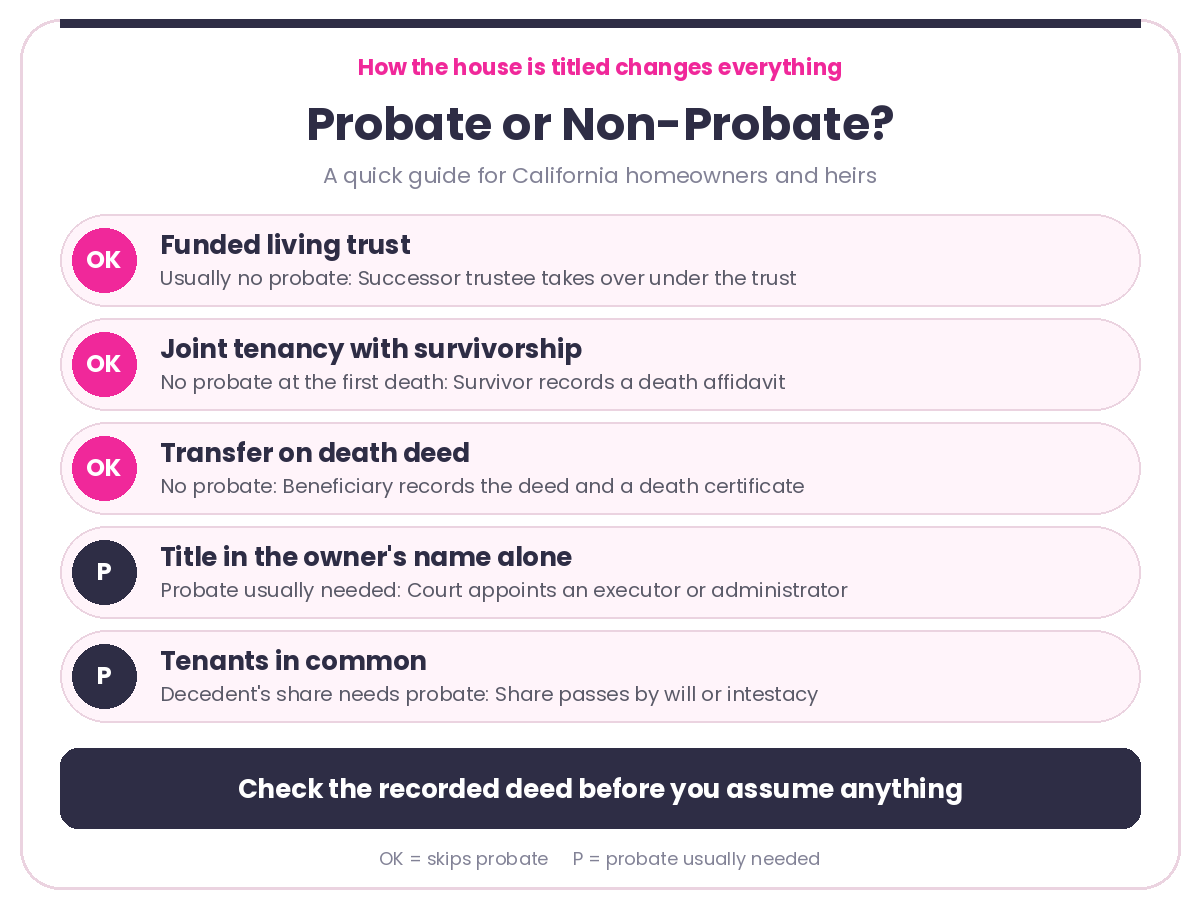
Probate is the court process that transfers property owned in a person's name alone. If the house was held in a way that already names who gets it next, the court usually does not need to be involved. Lawyers call these non-probate assets. The most common ways a California house avoids probate are a funded living trust, joint tenancy with right of survivorship, and a transfer on death deed.
A will, on the other hand, does not avoid probate. A will is simply the document the court reviews during probate to confirm who inherits.
Living Trusts: The House Skips Probate Only If It Is in the Trust
A revocable living trust is one of the most common estate planning tools in Southern California. The homeowner creates the trust, names themselves as trustee, and names a successor trustee to take over after death. When the trust owns the house, the successor trustee can manage and sell it according to the trust terms, usually without a court case.
The catch is something called funding. The house only belongs to the trust if a deed was signed and recorded moving it into the trust's name. This step is easy to miss. A family can have a beautiful trust binder, but the deed to the house was never changed, so the house is still titled in the owner's name alone.
When that happens, there are a few possible fixes. A pour-over will sends leftover assets into the trust, but those assets still go through probate first. In some cases, the successor trustee can file a petition under Probate Code section 850 (often called a Heggstad petition) asking the court to confirm that the owner intended the house to be in the trust. It is usually faster than a full probate, but it is still a court filing.
If the house is properly in the trust, the title company will typically ask for a certification of trust and a death certificate before closing a sale.
Joint Tenancy: The Survivor Takes It Automatically
When two or more people own a house as joint tenants with right of survivorship, the share of the person who dies passes automatically to the surviving owner or owners. The will does not control it, and probate is generally not required for that first death.
To clear the title, the survivor typically records an affidavit of death of joint tenant along with a certified death certificate with the county recorder, and files the property tax paperwork the county asks for. Married couples in California also commonly hold title as community property with right of survivorship, which works in a similar way for a surviving spouse.
A few cautions are worth knowing. The deed has to actually say joint tenancy. If the owners hold title as tenants in common, the deceased owner's share does not pass automatically and may need probate. Joint tenancy also only solves the first death. When the surviving owner passes away, the house is back in one name and the same question comes up again. And adding an adult child to a deed just to avoid probate can create gift tax, income tax, creditor, and property tax problems, so please talk with an estate attorney and a tax professional before doing it.
Transfer on Death Deeds: A Simple Tool With Strict Rules
California allows a revocable transfer on death deed, sometimes called a TOD deed, under Probate Code section 5600 and following. The owner signs a deed naming a beneficiary, keeps full ownership and control while alive, and can change or revoke it later. The beneficiary does not need to approve it, and it does not take effect until the owner dies.
The rules are what trip people up. The deed generally has to be signed, notarized, and recorded with the county recorder within 60 days of signing, and it has to be recorded before the owner passes away. A deed that is signed but never recorded, or recorded too late, may not work. After the owner's death, the beneficiary records a death certificate and files the required property tax paperwork to take title.
TOD deeds can be a great fit for a family home that is meant to go to one person or a few people, but they are not a substitute for a full estate plan. Creditor claims can still reach the property in some situations, and the law has specific requirements, so it is worth having an attorney prepare it.
Other Ways a House Can Skip Full Probate
Even if the house is in the owner's name alone, a full probate case is not always required. A surviving spouse may be able to use a spousal property petition, which is a shorter court filing. A primary residence of modest value can sometimes pass through a simplified Petition to Determine Succession to Real Property under Probate Code section 13151. The dollar limits for these shortcuts are adjusted every few years, so it is worth confirming the current numbers with an estate attorney.
When the House Does Still Need Probate
Probate is usually needed when the house is titled in the deceased owner's name alone and there is no trust, no survivorship, and no recorded TOD deed. It is also likely when a trust was created but never funded, when the owners held title as tenants in common, or when the person named to receive the house passed away before the owner.
The good news is that probate is a well-worn path, and a house can absolutely be sold through it. The court appoints an executor or administrator, and many California administrators receive authority to sell under the Independent Administration of Estates Act without a court confirmation hearing. A probate-experienced agent can help you plan the timeline from day one.
How to Find Out How the House Is Titled
Do not guess, and do not rely on what a family member remembers. The recorded documents will tell you. Here is where to start:
- Request a copy of the current recorded deed from the county recorder's office.
- Ask a title company for a property profile or preliminary title report, which shows how title is vested and lists recorded documents.
- Look for the name of a trust, the words "joint tenants," or a recorded transfer on death deed.
- Check whether an affidavit of death of joint tenant, or paperwork from a TOD beneficiary, has already been recorded.
- Bring what you find to an estate attorney before you list the home.
Selling a House That Skips Probate
When the house is in a trust, the successor trustee typically signs the sale documents, and no court confirmation or overbidding process is involved. When a surviving joint tenant has recorded the paperwork, they own the home outright and can sell it like any other homeowner. A TOD beneficiary generally records the required documents first and then lists the property.
Skipping probate does not mean skipping preparation. These homes often still need cleanout, repairs, pricing guidance, and a plan for family members who live in different places. That is where an agent who understands the process makes a real difference.
Common Mistakes to Avoid
- Assuming a will keeps the house out of probate.
- Creating a trust but never recording the deed that moves the house into it.
- Adding a child to the deed without talking to an attorney and a tax professional first.
- Signing a TOD deed but missing the recording deadline.
- Listing the home before confirming who has legal authority to sell it.
Let's Talk About Your Situation
Every family and every house is a little different. If you are not sure whether the home you are dealing with has to go through probate, I am happy to walk through it with you and connect you with the right professionals. Call, text, or book a free 20-minute consult. No pressure and no obligation to list.


This article is general information, not legal or tax advice. California probate, trust, and property tax rules are detailed and change over time, so please consult a licensed California estate attorney and a tax professional about your specific situation. Goli McDowell, REALTOR® and Certified Probate Expert, DRE# 02210125.
Categories
Recent Posts