What Happens to a House in California When Someone Dies Without a Will
When a California homeowner passes away without a valid will, the house does not sit in limbo. The California Probate Code immediately supplies a plan for it, whether the family agrees with that plan or not. This process, known as intestate succession, decides who inherits the property and how any eventual sale unfolds. Because California is a community property state, the rules work differently than in most of the country, and understanding them before you deal with the house can save heirs weeks of confusion and real money.
Intestate Succession Under California Law
California Probate Code sections 6400 through 6414 spell out exactly who inherits property when someone dies "intestate," meaning without a will. Unlike a simple flat hierarchy, California's rules first ask what kind of property the house is. That single question, community property or separate property, drives almost everything that follows.
Community Property vs. Separate Property
Community property is generally anything acquired during the marriage using marital earnings, which includes most family homes bought while married. Separate property is generally anything owned before the marriage, or received individually by gift or inheritance. Under Probate Code § 6401, the decedent's one-half interest in community and quasi-community property always passes entirely to the surviving spouse. Separate property is different: the spouse's share shrinks as more close relatives survive.
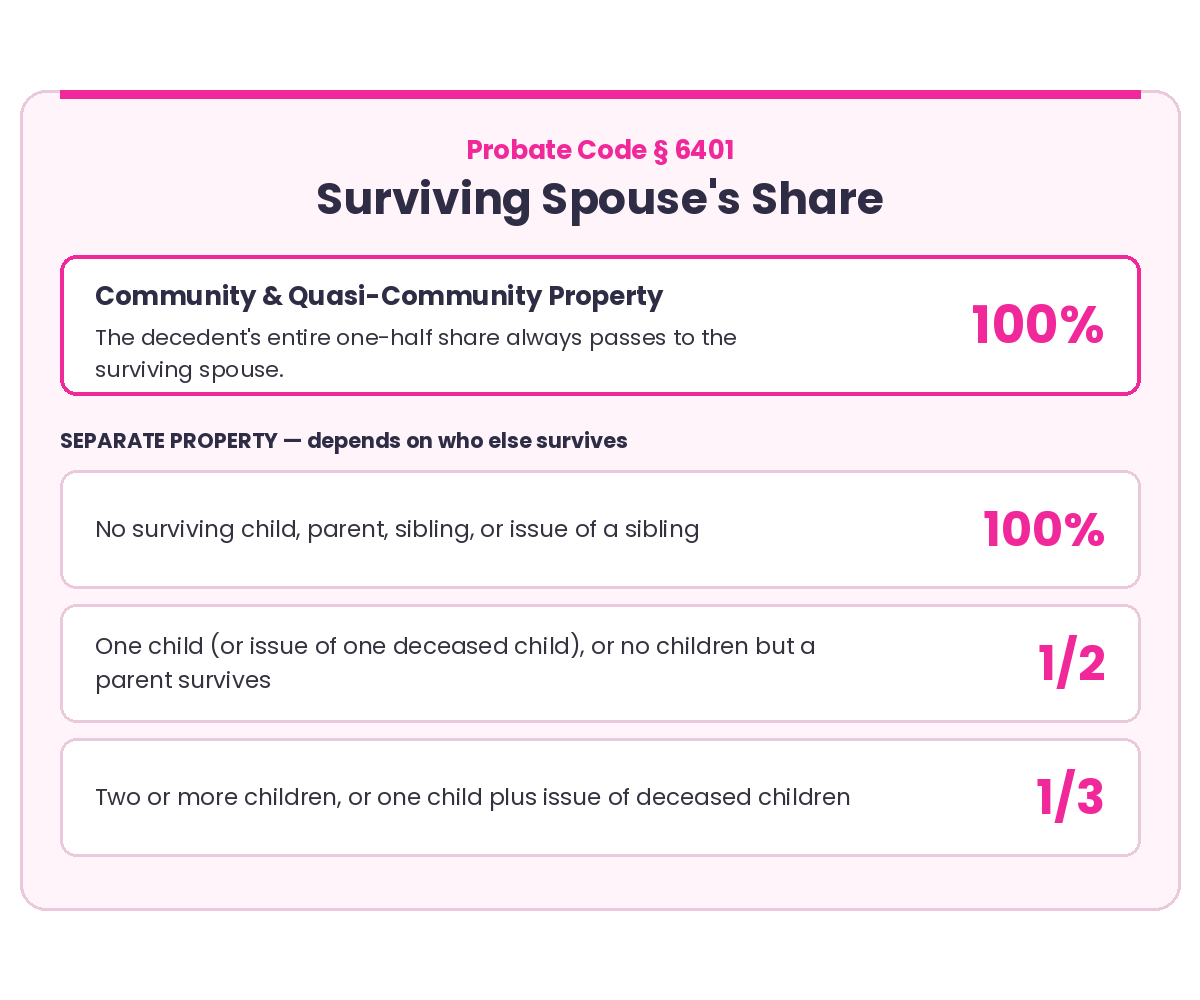
If there is a surviving spouse (Probate Code § 6401):
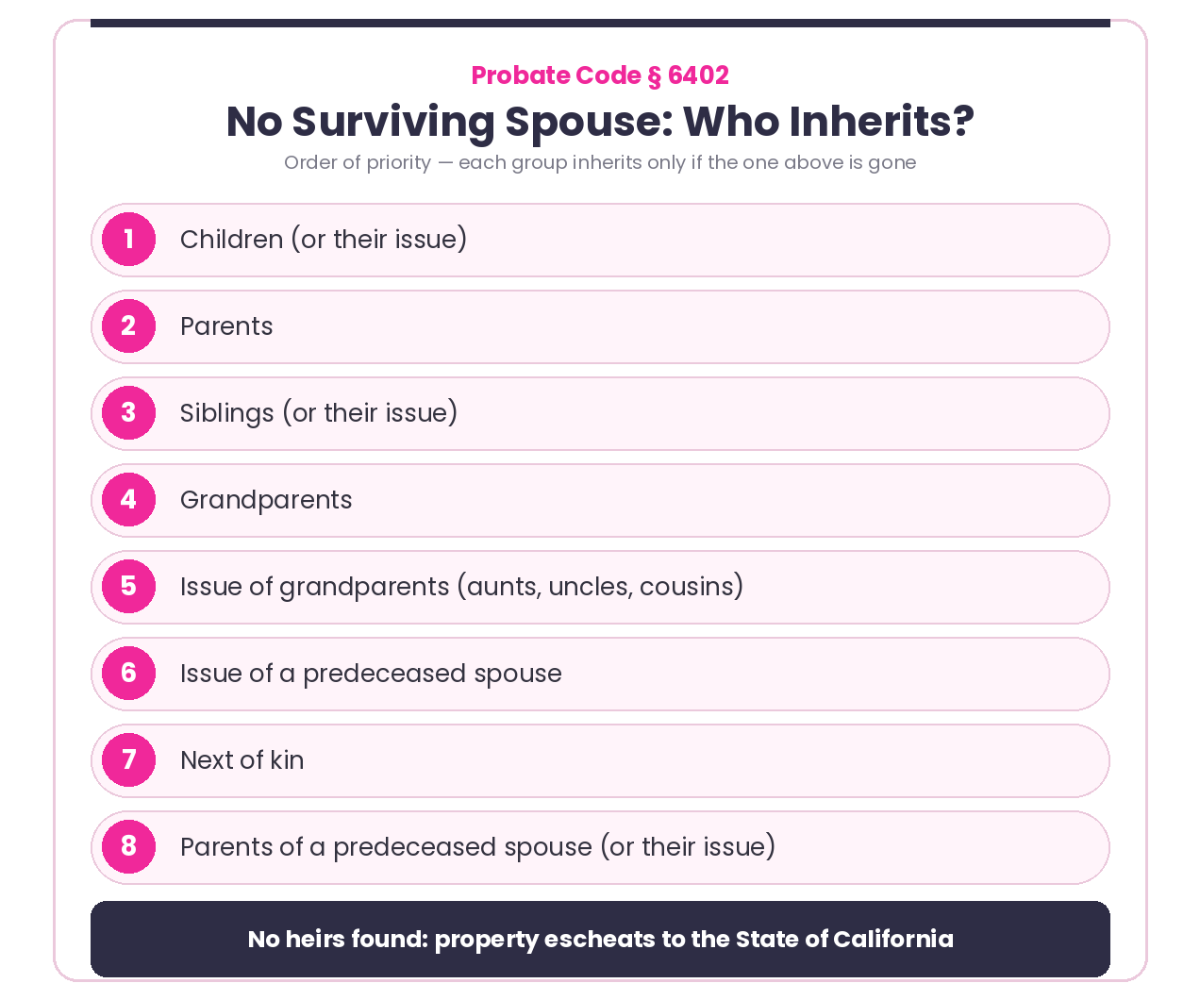
If there is no surviving spouse (Probate Code § 6402 order of priority):
If no heirs are found, the property escheats to the State of California.
The House Still Has to Go Through California Probate
Even though the Probate Code names the heirs, nobody shows up with a death certificate and simply gets the keys. The house is a probate asset, meaning it typically must pass through the Superior Court in the county where the decedent lived before it can be legally sold or transferred. The court appoints a personal representative, called an administrator when there is no will, usually the closest heir willing to serve. Many California administrators are granted full authority under the Independent Administration of Estates Act (IAEA), which lets them list and sell real property without a court confirmation hearing, so long as they serve a Notice of Proposed Action on the heirs and no one objects within 15 days. Without full IAEA authority, the sale instead requires formal court confirmation, including the possibility of overbidding at the hearing.
Small Estates May Skip Formal Probate
California offers several shortcuts that can avoid a full probate case. A spousal property petition can transfer community property to the surviving spouse on a faster track. A primary residence worth up to $750,000 can pass through a simplified Petition to Determine Succession to Real Property under § 13151. Very small estates may qualify for a personal property affidavit (the threshold adjusts periodically, and sits at $208,850 for deaths before April 1, 2026, rising to $239,700 after that date) or, for modest real property outside a primary residence, an affidavit under § 13200 once six months have passed since death. An estate attorney can quickly confirm which of these applies.
When Multiple Heirs Inherit Together
It is common in intestate cases for two or more heirs, siblings for example, to inherit a house together as co-owners, known as tenants in common. None of them can force the others to sell just because they would prefer to, but any one of them can file a partition action in California Superior Court if the group cannot agree. That route is usually slower and more expensive than agreeing to sell voluntarily, so families are almost always better served getting professional guidance early, before disagreements have a chance to harden.
A Few Things That Skip Probate Entirely
Not every detail here is grim news. Property held in joint tenancy with right of survivorship, inside a living trust, or titled with a California revocable transfer-on-death deed (available since 2016 under Probate Code § 5600 et seq.) passes directly to the co-owner or named beneficiary outside of probate and outside intestate succession law altogether. It is worth checking the deed before assuming a full probate case is required.
What Heirs Should Do Next
If you are an heir, or a newly appointed administrator, facing an intestate house in California, the practical next steps are largely the same. Confirm who was formally appointed by the Superior Court and whether they hold full IAEA authority, obtain the date-of-death appraisal from the court-appointed probate referee, secure the home and notify the insurance carrier, and loop in a probate attorney and a probate-experienced California real estate agent early, before listing rather than after an offer arrives. Selling a California probate property carries its own timeline, disclosure rules, and sometimes court-confirmation requirements that a standard residential sale simply does not have.


California intestate succession law is detailed and fact-specific, and this article is general information rather than legal advice. Anyone settling a California estate without a will should consult a licensed California estate attorney before making decisions about the property. Goli McDowell, REALTOR® and Certified Probate Expert, DRE# 02210125.
Categories
Recent Posts